Kioxia Earnings & AI Semiconductor Surge: How the BaZi 'Wealth Star' Decodes Tech Industry Profit Cycles
In late October 2026, Japan's memory giant Kioxia reported strong earnings, and together with SK Hynix's outperformance, the AI semiconductor sector soared, pushing the Nikkei higher. Beyond the industry logic, can traditional BaZi astrology
Opening Introduction
In late October 2026, Japanese memory giant Kioxia released robust earnings, and with SK Hynix beating expectations, the AI semiconductor segment rallied collectively, extending the Nikkei's gains. Amid the market euphoria, let's shift perspective: in BaZi astrology, this tech profit wave corresponds to a concentrated burst of Wealth Star energy.
The Wealth Star in BaZi is not a mere money symbol; it represents resources, liquidity, and value realization. The expansion and contraction of the semiconductor industry mirrors the waxing and waning of the Wealth Star in a destiny chart. Using the Kioxia news as an entry point, this article unveils the unique logic of traditional destiny analysis in viewing tech cycles.
Whether you are an investor or an industry observer, understanding the interaction of Output Producing Wealth and Peer Robbing Wealth can help you cut through market noise and grasp the deep rhythm behind the tech wave.
Basic Clarifications
Common Misconceptions
- Misconception 1: The BaZi Wealth Star means directly striking it rich. In reality, the Wealth Star represents what the Day Master controls—the resources and value output you can manage, not your account balance.
- Misconception 2: The stronger the Wealth Star, the better. Destiny analysis emphasizes balance. An overly strong Wealth Star without restraint can symbolize unchecked desire or a risk of capital chain rupture, just like semiconductor overcapacity.
- Misconception 3: To evaluate a company, just look at the Wealth Star. A tech company's core competitiveness often lies in Output (innovative technology) and Officer/Authority (market rules); the Wealth Star is merely the final outcome.
- Misconception 4: Industry cycles can precisely predict stock prices. Destiny analysis reveals energy trends; it cannot replace financial models and should never be used as a basis for short-term trading.
Correct Understanding of the Wealth Star
In the BaZi Ten Gods system, the Wealth Star divides into Direct Wealth and Indirect Wealth. Direct Wealth represents stable revenue and core business profit; Indirect Wealth signifies unexpected gains, investment returns, or blockbuster product earnings.
For tech companies, Direct Wealth is like long-term contracts and licensing revenue, while Indirect Wealth resembles a stock price surge driven by an AI boom or a one-time super order. The two interact to form the profit cycle.
The source of the Wealth Star is Output (innovation and technology); its threat is Peer (competition). Understanding this generating-overcoming chain is key to interpreting the semiconductor industry.
- Direct Wealth: Steady operations, like Kioxia's stable NAND flash shipments.
- Indirect Wealth: Opportunistic bursts, such as a sudden spike in demand for HBM memory driven by AI servers.
- Output Producing Wealth: R&D investment converting into product profit—the healthiest profit model.
- Peer Robbing Wealth: Multiple manufacturers expanding simultaneously, leading to price wars and diluted profits.
Core Insights
Essence of the Wealth Star: Viewing Tech Monetization Through 'What I Control'
BaZi centers on the Day Master; the Five Element that the Day Master controls is the Wealth Star. A semiconductor company transforms technology (Output) into products and exchanges them for profit in the market—a classic path of Output Producing Wealth.
Kioxia's NAND flash is the product of its R&D capability (Output); selling it generates revenue (Wealth). When AI demand explodes, the Output energy is dramatically amplified, and the Wealth Star surges accordingly.
But the Wealth Star also needs the Officer Star for protection—intellectual property rights and market access—otherwise it can easily be robbed by competitors. The Officer Star also represents industry standards that regulate market order.
If a company's Day Master is too weak while the Wealth Star is overly strong, a 'rich house, poor person' phenomenon occurs—abundant orders but delivery difficulties, ultimately backfiring.
- Day Master: The company's core capability and positioning, such as Kioxia's accumulated expertise in storage.
- Output: R&D innovation and products, the source of the Wealth Star; AI chip design is a typical Output.
- Wealth Star: Revenue, profit, market share—the result of Output monetization.
- Officer/Authority: Industry standards, regulations, patent barriers—protecting the Wealth Star from being robbed.
Semiconductor Cycles and the Waxing and Waning of the Wealth Star
The semiconductor industry exhibits distinct boom-bust cycles. BaZi uses the theory of strength and weakness to explain this rhythm: when a luck pillar or annual pillar activates the Wealth Star and the star is well-rooted, the industry thrives; when the Wealth Star is suppressed or enters the grave stage, a downturn sets in.
Memory chip price fluctuations can be seen as a manifestation of Peer Robbing Wealth. When multiple manufacturers expand simultaneously, Peers (competitors) become too strong and snatch the Wealth Star, causing prices to fall and margins to thin.
Conversely, when new demand from AI applications emerges, Output (innovation) suddenly strengthens, generating the Wealth Star, breaking the old balance and initiating a new expansion. SK Hynix's HBM is a prime example of Output Producing Wealth.
The twelve life stages in BaZi (Growth, Bathing, Youth, Official, Peak, Decline, Sickness, Death, Grave, Extinction, Embryo, Nurture) can delicately depict an industry's entire journey from germination to decline, closely matching the semiconductor cycle.
- Wealth Star Receiving Support: Annual pillar encounters Output or Wealth Star itself; demand explodes, as in the 2023-2024 AI wave.
- Wealth Star Suppressed: Encountering Peer Robbing Wealth or excessive Officer pressure; overcapacity, sanctions.
- Cycle Nodes: 'Peak' marks the top, 'Decline' the turning point, 'Grave' the trough and industry shakeout.
- Climate Adjustment Factor: Semiconductors require a high balance of Water and Fire; if supply chain disruptions break this balance, even a strong Wealth Star cannot be realized.
Expansion Timing: How Luck and Annual Pillars Trigger Growth
Traditional destiny analysis sees expansion keyed to whether the Wealth Star has root energy and whether Output is robust. If a company's chart meets a Wealth Star annual pillar that is favorable and rooted, it is suitable for increasing investment.
Taking the current AI semiconductor boom as an example, if we view the industry as a whole chart, 2024 Jia Chen year has Jia Wood as Output (innovation), generating the Wealth Star Fire (profit)—a good year of Output Producing Wealth.
2026 Bing Wu year features strong Fire, with the Wealth Star at an extreme. Kioxia's stellar earnings reflect this peak Wealth Star energy, but if Fire becomes overly blazing and scorching, a shift from prosperity to decline may follow.
Expansion also requires checking whether Peer helps the Day Master. If the annual Peer combines with the Day Master, it signals collaboration and M&A opportunities, allowing growth through partnership rather than pure competition.
- Judgment Criteria: The luck pillar's heavenly stem is Wealth or Output, favorable to the Day Master, with earthly branch root.
- Expansion Signal: The annual Wealth Star merges into the chart, or Output emerges strongly, without the Officer Star being harmed.
- Risk Warning: An overly strong Wealth Star with a weak Day Master becomes a burden, like a company over-leveraging for expansion.
- Strong Body Can Handle Wealth: The company's capacity, talent, and management must match the market opportunity.
Contraction Timing: Peer Robbing Wealth and Officer Suppressing the Body
Contraction often occurs in age luck dominated by Peer. Peer represents industry competitors and overcapacity. When Peer Robs Wealth, company profits are diluted, forcing spending cuts.
Another contraction signal is excessive Officer/Authority. Officer represents pressure, regulation, and market barriers. If the annual Officer attacks the Day Master, the company faces tightening policies or technology blockades; even if wealth exists, it cannot be obtained.
The period of plummeting memory chip prices is a classic manifestation of Peer Robbing Wealth. At such times, as destiny principles advise, when Peers divide the wealth, it is better to defend than to attack—preserve cash flow and wait for the next Output Producing Wealth cycle.
When Officer is too strong, use the Resource Star to dissolve it. The Resource Star represents technology accumulation, patents, and brand reputation; it can clear the path through Officer, protect the Day Master, and accumulate strength for the next expansion.
- Peer Robbing Wealth: Competitors expanding, price wars, declining margins—like cyclical DRAM crashes.
- Officer Suppressing Body: Trade restrictions, technology bans, blocked market access, geopolitical shocks.
- Countermeasure: Strengthen the Resource Star (tech accumulation, patents) to dissolve Officer, or combine Peers (alliances).
- Retreat Strategy: Proactively cut production and reduce spending, matching the destiny pattern of 'following weakness' to preserve strength.
AI Semiconductor's Special Wealth Star: Indirect Wealth and Windfall
The demand explosion brought by AI is sudden and explosive, aligning more closely with Indirect Wealth in destiny analysis. Indirect Wealth governs unexpected big money—arriving fast and potentially departing just as quickly.
The sharp gains in Kioxia and SK Hynix shares are a release of Indirect Wealth energy. But Indirect Wealth requires Peer to help the body catch it—meaning the company must have sufficient production capacity and supply chain support.
If a company's Day Master is weak, great Indirect Wealth can lead to 'rich house, poor person,' with abundant orders but inability to deliver. Hence, AI semiconductor firms must balance Wealth and Body.
Indirect Wealth also carries a speculative tint. If a company over-relies on the trend, once Output innovation stagnates, the Wealth Star will rapidly retreat, and the stock price will correct violently.
- Indirect Wealth Traits: Explosive growth, sharp stock price rises, one-time large orders—like urgent AI server orders.
- Strong Body Required: The company's capacity, talent, and management must keep pace to catch the wealth.
- Indirect Wealth Risk: After the trend fades, if Output innovation stalls, the Wealth Star quickly loses energy.
- Balancing Direct and Indirect Wealth: Combining stable Direct Wealth (long-term orders) with Indirect Wealth (trend dividends) is ideal.
Five Element Perspective: The Destiny Attributes of the Semiconductor Industry
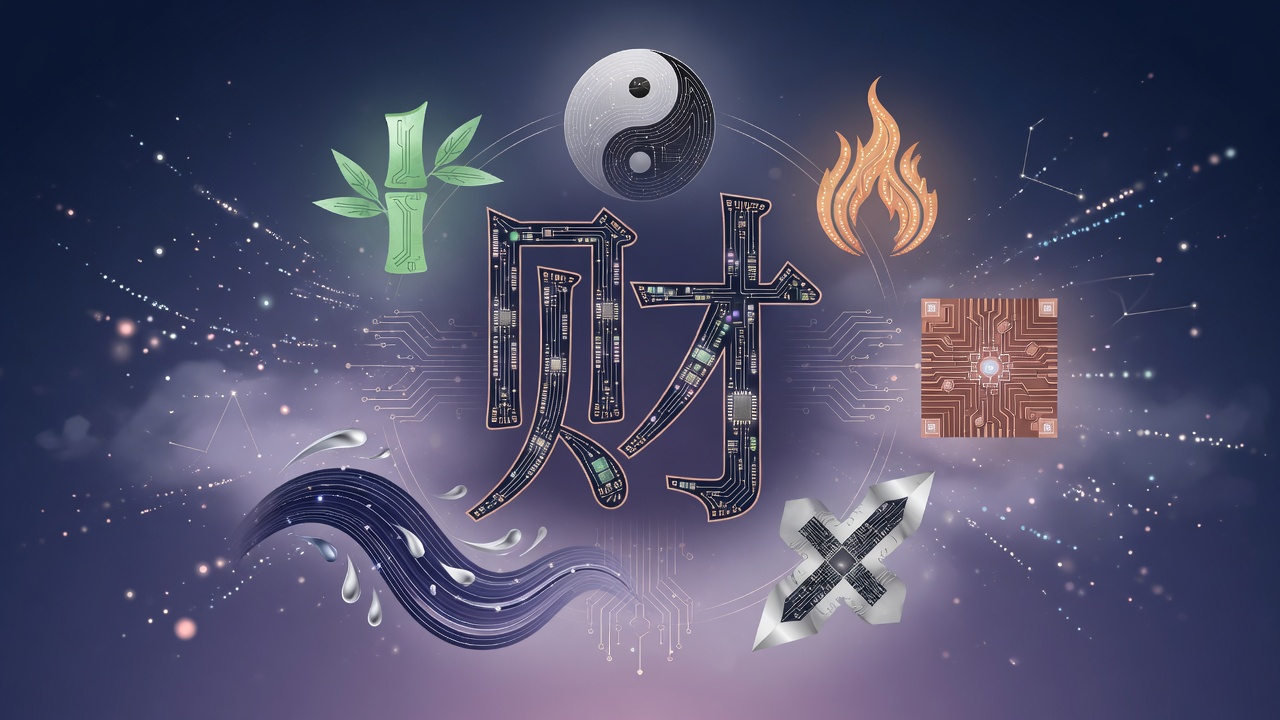
Semiconductor manufacturing involves multiple Five Elements: lithography uses Fire, wafers belong to Metal, cleaning uses Water, packaging carries Earth, and design is attributed to Wood. Overall, Metal dominates because silicon is the core material and the process is precise like a blade.
Metal's Wealth Star is Wood, which represents innovation, design, and AI algorithms. Therefore, the AI-driven semiconductor boom is essentially Wood (Output) generating Fire (Wealth)? Actually, Wood is Metal's wealth—Metal controls Wood as wealth—but Wood can also produce Fire.
More precisely, a semiconductor company takes Metal as its body and Wood as its function (design). Wood generates Fire (market heat), and Fire in turn controls Metal (demand forcing manufacturing), forming a complex cycle.
Understanding the Five Element generating-overcoming interactions helps us see the prosperity transmission across different segments of the industry chain. For example, thriving AI chip design (Wood) drives manufacturing demand (Metal), which then pulls equipment (Metal) and materials (Earth).
- Metal: Wafer manufacturing, equipment—representing precision and value.
- Wood: Chip design, AI algorithms—the source of innovation, Metal's Wealth Star.
- Fire: Lithography, market heat—representing energy and explosion.
- Water: Cleaning, cooling—also represents capital liquidity.
- Earth: Packaging, testing—representing bearing and stability.
Pitfall Avoidance Guide
Notes for Corporate Destiny Application
- Don't focus solely on the Wealth Star: Tech companies prioritize Output (R&D) first. With robust Output, the Wealth Star will naturally flow continuously. Chasing only the Wealth Star while neglecting R&D is like draining the pond to catch fish.
- Industry charts cannot be applied rigidly: The semiconductor industry overall belongs to Metal, but different segments have different emphases; analysis must combine specific sub-sectors.
- Annual pillars are only for reference: BaZi reveals trends, not a substitute for financial models and market research. Expansion decisions still require real-world data support.
- Pay attention to climate adjustment: Semiconductors require a high balance of Water and Fire. If the annual pillar disrupts this balance (e.g., supply chain disruptions, water or power shortages), even a strong Wealth Star cannot be realized.
- Avoid single-indicator analysis: Comprehensively evaluate the power balance of Output, Wealth Star, Officer, and Resource Star to fully assess a company's fortune.
Notes for Personal Investment Reference
- A strong Wealth Star year does not mean everyone gains: If an individual's chart treats Wealth as an unfavorable god, chasing the rally may lead to buying at the top and getting trapped.
- Be cautious about following trends in Peer Robbing Wealth years: When overcapacity signals emerge, those with strong Peer in their charts should avoid blindly increasing positions.
- Output Producing Wealth is the virtuous cycle: Choose companies that continuously invest in technological innovation (Output); their Wealth Star is more sustainable.
- Officer protecting Wealth cannot be ignored: Pay attention to a company's patent barriers and compliance capabilities—these are the guarantees that the Wealth Star won't be robbed.
- Take profits in Indirect Wealth years: AI-driven surges often come with severe volatility. In strong Indirect Wealth luck, it is advisable to lock in gains and avoid greed for the last leg.
Summary and Recap
Kioxia's earnings and the AI semiconductor rally vividly illustrate the Wealth Star energy in the tech industry. Output Producing Wealth reveals innovation-driven profits, Peer Robbing Wealth warns of overcapacity, and Indirect Wealth explains windfall booms. Traditional destiny analysis, with its principle of balance between strength and weakness, offers a unique Eastern lens to understand semiconductor expansion and contraction cycles. Remember: the Wealth Star is the result, Output is the engine, and a Strong Body is the foundation. In the next cycle, grasp Output innovation and guard against Peer Robbing Wealth to ride the tech wave rhythm.