The Bazi Code in Kabuki Processions: Yin-Yang, Five Elements, and the Aesthetics of Destiny in Japanese Traditional Art
In November 2026, the grand Tachikawa Tachihi Kabuki Procession took place, with Kataoka Nizaemon performing the first 'o-neri' in Tokyo in 29 years, drawing cheers and unconventional shouts of support. This surge of Edo-period flair is a per
Opening Introduction
As Kataoka Nizaemon walked slowly through the streets of Tachikawa in opulent costume, the onlookers didn't just shout the traditional 'Naritaya!'—they also improvised unique cheers. This procession is not only a Kabuki celebration but also a gateway to the fusion of Bazi destiny analysis and traditional performing arts.
From the perspective of Yin-Yang and the Five Elements, this article rationally explores how a Kabuki actor's destiny character resonates with their roles, revealing the Eastern aesthetic logic hidden behind stylized performance.
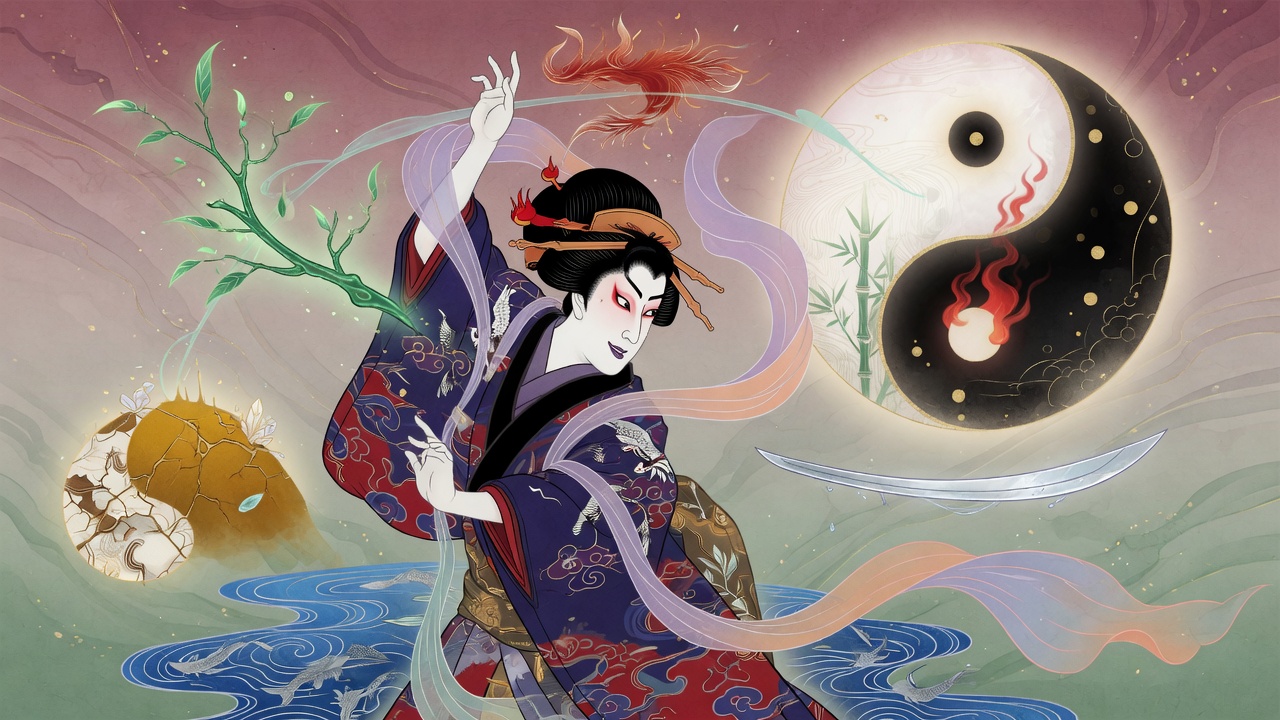
Basic Clarification: Bazi and Kabuki Are Not Mystical Analogies
Common Misconceptions
- Misconception 1: Bazi is a fortune-telling tool unrelated to art. In reality, the Bazi system is fundamentally a spatiotemporal energy study, and its Yin-Yang and Five Elements classification is highly isomorphic with Kabuki's symbolic systems such as kumadori, costumes, and music.
- Misconception 2: An actor's Bazi determines their roles. Not true. Bazi provides an innate temperamental tendency, while the role is an acquired construct. Between the two exists a kind of mirror resonance, not mechanical determinism.
- Misconception 3: One can publicly analyze an actor's birth chart for destiny analysis. This article strictly observes the principle of not fabricating private information. It only discusses general destiny aesthetics based on common Five Elements patterns and does not target any specific individual.
Why Bazi Can Dialogue with Kabuki
Kabuki was born in the early Edo period, and its aesthetic foundation is deeply rooted in Shinto, Buddhism, and Confucianism—all of which are intimately connected with Yin-Yang and Five Elements theory.
Stage orientation, color symbolism, and rhythmic tempo are all concrete manifestations of the generating and overcoming cycles of the Five Elements. And since a Bazi chart is the Five Elements configuration at an individual's moment of birth, it naturally becomes a key to interpreting the chemistry between an actor and their role.
Core Insights: Kabuki Aesthetics in the Flow of the Five Elements
1. Yin-Yang and Five Elements: The Invisible Framework of the Kabuki Stage
The Kabuki stage's joshiki-maku (standard curtain) is presented in three colors: black, red, and green, corresponding respectively to the Five Elements energies of Water, Fire, and Wood. Black (Water) symbolizes solemnity and the abyss; red (Fire) represents passion and conflict; green (Wood) signifies growth and hope.
The actor's kumadori (face painting) is even more a palette of Five Elements philosophy. Red kumadori is mostly used for righteous heroes, belonging to Fire, displaying righteous fury; blue kumadori is used for villainous vengeful spirits, belonging to Water, implying cold obsession.
The positional design of the hanamichi also aligns with the Five Elements. Extending from the audience's left side, the left is East, belonging to Wood, governing the energy of growth. When an actor makes their entrance from here, it symbolizes the character moving from chaos into order.
- Five Elements Musicality: The sharp timbre of the shamisen belongs to Metal, the deep resonance of the taiko drum belongs to Earth, and the lingering flute belongs to Wood. When played together, they form an energy flow of Metal overcomes Wood, Wood generates Fire, steering the audience's emotions.
- Seasonal Repertoire: Performing 'Soga Monogatari' in the New Year draws on the rising Wood energy; performing 'Yotsuya Kaidan' in summer borrows Water energy to quell the fiery season. Both are applications of Five Elements harmony.
2. Day Master and Ten Gods: Role Mapping of an Actor's Destiny Character
The Day Master in a Bazi chart represents the self, and its Five Element attribute can outline an actor's foundational temperament. Different Day Masters and Ten Gods combinations often create a natural affinity with specific Kabuki role types.
The following is a general deduction, not involving any real actor's private information, and is solely a rational discussion of destiny aesthetics.
- Jia Wood Day Master (Yang Wood): Like a towering tree, upright and possessing leadership qualities. If such an actor has Direct Officer prominent, they easily excel in tachiyaku (righteous male lead), such as Ōishi Kuranosuke in 'Chūshingura'—firm and resolute, Wood governing benevolence.
- Bing Fire Day Master (Yang Fire): Like the light of the sun, passionate and exuberant. If accompanied by Eating God, they are suited for aragoto (rough, martial roles), like Kamakura Gongorō in 'Shibaraku'—fiery nature soaring, with immense stage explosiveness.
- Geng Metal Day Master (Yang Metal): Like a sharp sword, tough and decisive. Those with Seven Killings can often delve deep into the psyche of katakiyaku (villain roles), such as Musashibō Benkei in 'Yoshitsune Senbon Zakura'—the killing energy of Metal expresses the struggle between loyalty and righteousness.
- Ren Water Day Master (Yang Water): Like a rushing river, wise and profound. If Indirect Resource is strong, they can master wagoto (tender, romantic male roles) or onnagata (female roles). The flowing nature of Water understands human sentiment, as seen in Kumo no Taema Hime in 'Narukami'—Water's soft allure and intelligence coexist.
- Wu Earth Day Master (Yang Earth): Like a thick city wall, bearing all things. Those with Direct Resource are skilled in fukeoyaku (old man roles). Earth governs trustworthiness, steady and reliable, able to bring to life Takebe Genzō in 'Sugawara Denju Tenarai Kagami'.
- Ten Gods Combinations: Actors with Hurting Officer paired with Resource often achieve extraordinary mastery in onnagata (female roles). The sensitivity of Hurting Officer and the cultivation of Resource enable precise capture of feminine psychology. Actors with Eating God controlling Seven Killings excel at portraying complex villains, using Eating God's warmth to dissolve Seven Killings' ferocity, creating sympathetic antagonists.
3. Luck Pillars and Annual Cycles: Succession, Productions, and Five Elements Periods
The shūmei (name succession) system in the Kabuki world is essentially a Five Elements transmission ritual. The name itself carries the Five Elements aura of generations of great actors, and the successor, by adopting the illustrious name, continues a certain Five Elements energy.
Luck Pillars change every ten years, and many actors experience artistic turning points at the transition. For example, shifting from onnagata to tachiyaku, or from nimaime to fukeoyaku, often synchronizes with changes in the Five Elements of the luck pillar.
- During a Fire Luck period: The actor's passion surges, producing many aragoto and jidaimono (historical plays) with a performance style tending toward exaggeration and extroversion.
- During a Water Luck period: Turning inward, they delve into sewamono (domestic plays) with greater emphasis on psychological portrayal. Kataoka Nizaemon's deep cultivation of ninjōbon (human-feeling stories) in his later years may be related to the Water energy of his luck cycle.
- Five Elements Balance: Top-tier great actors often have a Bazi chart where the Five Elements circulate smoothly without major imbalance, thus enabling them to excel in multiple role types. For example, the second-generation Matsumoto Hakuō performed tachiyaku, onnagata, and fukeoyaku—a manifestation of balanced Five Elements.
- Annual Cycle Correspondences: Important events like processions and New Year productions are often scheduled in Wood or Fire annual cycles, drawing on the image of Wood and Fire flourishing and popularity booming. This Tachikawa procession happened to be in a Bing Wu year, a blazing Fire momentum fitting the grand occasion.
4. The Aesthetics of Kata: Bazi Structures and Performance Stylization
Kabuki's kata (stylized performance patterns) are highly condensed Five Elements symbols. Whether an actor can breathe life into the kata depends on whether their destiny chart can resonate with the Five Elements of the kata.
Those with pure structures are adept at expressing individuality within strict forms; those with mixed structures may break through the constraints of kata and pioneer new styles.
- Direct Officer Structure: Emphasizes rules, faithfully inheriting kata, like conservative master actors whose every movement aligns with ancient methods—the Officer star protects the kata.
- Seven Killings Structure: Possesses a reforming impulse, often modifying kata, such as the first-generation Ichikawa Ennosuke creating Super Kabuki—the Killing star destroys the old to establish the new.
- Eating God Structure: Adds leisurely charm to kata, endowing characters with a sense of lived reality—Eating God governs natural expression.
- Hurting Officer Structure: Overflowing with talent, may subvert traditional kata to create astonishing performances, but needs the Resource star to prevent excess.
Practical Guide: Rationally Appreciating Destiny Aesthetics Without Overstepping
Points of Caution
- Do Not Fabricate Birth Times: Any analysis of an actor's Bazi must be based on publicly verifiable birth information and should only serve as cultural discussion, never involving privacy intrusion. All cases in this article are general Five Elements deductions and do not point to specific individuals.
- Do Not Predict Reality: Bazi analysis is limited to the aesthetic level of artistic character and role suitability. It is strictly forbidden to predict an actor's health, marriage, lifespan, or any real-world events, and must not be used for competition results, political leanings, etc.
- Do Not Be Superstitious: The correspondence between the Five Elements and roles is a form of symbolic thinking, not a scientific law. An actor's success depends more on training, opportunity, and personal effort. Destiny analysis is merely an interesting lens for interpreting their artistic style.
- Respect Tradition: Kabuki is an important intangible cultural property of Japan. Discussions should maintain respect and avoid using destiny analysis to disparage or deify any school or individual.
- Cultural Differences: Bazi originated in China and differs from Japanese Nine Star Ki and Four Pillars Astrology. Readers should note the conceptual distinctions and not equate them entirely.
- Rational Sharing: When sharing on social platforms, emphasize its cultural aesthetic value rather than manufacturing mysticism, to avoid provoking inappropriate speculation.
Summary and Recap
Within the clamor of the Tachikawa procession lies the quiet rhythm of Yin-Yang and the Five Elements. Bazi destiny analysis is not a divination tool but a set of aesthetic language for interpreting the deep resonance between Kabuki actors and their roles.
From the colors of kumadori to the orientation of the hanamichi, from the temperament of the Day Master to the role mapping of the Ten Gods, the generating and overcoming cycles of the Five Elements permeate the creation and transmission of Kabuki. By rationally applying this perspective, we can more profoundly appreciate the destiny aesthetics within traditional performing arts while staying far from the quagmire of superstition.