The Child Connection and Bazi Choices: How Destiny Insights Reveal the Wisdom of Parent-Child Relationships Amid Changing Times
Recently, Daewoo Engineering & Construction invited employees' children to its headquarters, conveying warmth through the message “가족과 추억 쌓아” (building memories with family). This mirrors the enduring East Asian focus on children's growth. In Korean
Opening Introduction
When a company captures the smiling faces of children, we feel not only warmth but also a timeless collective subconscious: children carry the hopes and future of a family. In Bazi culture, this profound emotion is abstracted into a sophisticated symbolic system—the children’s star and the time pillar.
This article does not predict a child’s fate; instead, it guides you into the logic of traditional destiny analysis to understand innate personality tendencies, key decision points for parents, and how the flow of time quietly weaves the fabric of parent-child relationships.
Basic Clarification: How Bazi Interprets Children
The Children’s Star is Not a Physical Planet
- Misconception One: The children’s star refers to a specific star. In fact, in Zi Ping Bazi, the children’s star is a concept within the Ten Gods system. For males, the children’s star is Officer/Killing (Zheng Guan, Qi Sha); for females, it is Food/Injury (Shi Shen, Shang Guan).
- Misconception Two: Reading children only through the time pillar. Although the time pillar represents old age and the children’s palace, the strength and favorability of the children’s star must be judged in the context of the entire chart, including Day Master strength and Five Element interactions.
- Misconception Three: A strong children’s star means excellent children. If it is an unfavorable god without restraint, strength actually indicates high nurturing pressure or draining interactions, not simple good fortune.
The Core Meaning of the Time Pillar
The time pillar is the palace of children, symbolizing late fortune and fruits. Its Five Element and Ten God directly depict a child’s innate endowment tendencies. For example, a time pillar with Food often indicates a gentle, quiet child; one with Injury suggests an active, unconventional mind.
Core Insights: Personality Base, Parental Choices, and Flow of Time
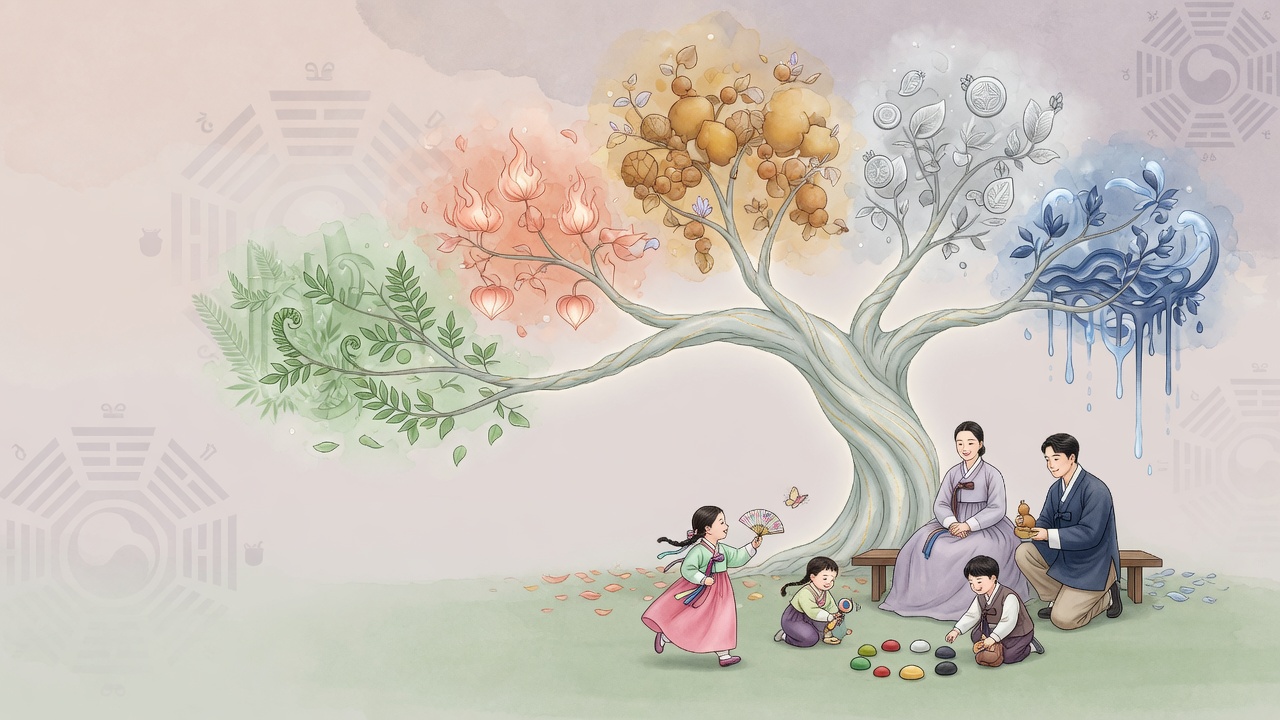
Five Element Personality Map of the Children’s Star
A child’s personality genes are foreshadowed in the chart. By observing the Five Element nature of the children’s star, we can understand natural tendencies and choose more compatible guidance styles in education.
- Wood-type children’s star (e.g., Jia Wood Food): upward growth, loves learning, compassionate. Such children thrive in relaxed, exploratory environments; suppression makes them wither.
- Fire-type children’s star (e.g., Bing Fire Killing): passionate, active, leadership desire and explosive energy. Parents need to channel their enthusiasm into long-term goals to avoid fleeting interests.
- Earth-type children’s star (e.g., Wu Earth Officer): honest, steady, good at accumulation but possibly overly conservative. Provide ample practical opportunities to develop adaptability.
- Metal-type children’s star (e.g., Geng Metal Injury): sharp, decisive, values loyalty, speaks directly. Teach empathy and transform critical thinking into problem-solving skills.
- Water-type children’s star (e.g., Ren Water Food): intelligent, agile, highly adaptable but prone to fluctuation. A stable and understanding environment helps precipitate profound wisdom.
Parental Choices: The Code of Parent-Child Interaction under Luck Cycles
Bazi is not fatalism but a timing map of choices. The parents' own luck cycles deeply influence how they treat their children, indirectly shaping the child’s trajectory.
- Parents with overly strong Resource (Yin) star: highly protective, tend to make decisions for the child. When luck brings the Wealth star that breaks Yin, it’s a chance to learn to let go. If they adapt, the child’s independence can improve.
- Parents with strong Peer (Bi Jie) star: competitive, may unconsciously project their own standards onto the child. When luck brings Food/Injury to vent the Self, they suddenly appreciate the child’s uniqueness, and the relationship softens.
- Parents with strong Wealth star: value realistic achievements, care about material security. When luck brings Officer/Killing, they may pressure the child with rules and expectations. Proactively introducing the Resource (Yin) mindset of understanding and listening is key to resolving conflicts.
- Timing of childbirth: Although not a prediction, Bazi theory suggests that when parents conceive during their own favorable luck or a year when the children’s star is clear and unperturbed, their mindset is more relaxed, providing a more stable early energy field. This is a wisdom of going with the flow.
Flow of Time: Interpreting the Children’s Star in Social Change
In East Asian societies like Korea, the collective anxiety over children is unprecedented. Bazi culture offers a unique stress-relief logic: destiny always discusses combinations, never absolute levels.
- Food Restrains Killing (Shi Shen Zhi Sha): Traditionally seen as both civil and martial talent. In modern terms, the child is adept at converting pressure (Killing) into creative output (Food). Parents who understand this don’t force rote learning but guide project-based exploration.
- Injury Matched with Resource (Shang Guan Pei Yin): Talent meets academic discipline. When this combination appears in the time pillar, the child often needs a knowledge framework (Yin) to harness their runaway brilliance (Injury). In the information age, teaching critical filtering is more important than cramming.
- Children’s star in Emptiness or Double Resonance (Fu Yin): Does not mean no children or bad fortune; it hints that the parent-child interaction needs more patience and space. In modern times, high-pressure work culture amplifies this distance. Consciously creating “aimless” parent-child time can alleviate this.
Avoiding Pitfalls: Common Destiny Misconceptions for Modern Parents
Precautions
- Don’t judge a child’s achievement by a single pillar: Bazi is a symphony of eight characters. Judging academic or career success by the time pillar alone is like judging a garden by one petal. You must combine the year, month, day, and luck cycles, especially the parents’ own charts.
- An unfavorable children’s star doesn’t mean a bad child: If the children’s star is an unfavorable god, it only indicates that nurturing may drain energy, health, or finances. It absolutely does not represent a flaw in the child’s character or ability. Many great figures were “headache” unfavorable stars for their parents.
- Don’t blindly pursue a “perfect” time pillar: The social trend of selecting auspicious birth times via cesarean section overlooks that Bazi emphasizes innate qi; a natural birth time aligns more closely with family karma and the child’s true path. Forced intervention often backfires.
- Avoid annual panic: Seeing the children’s palace clashed or the star attacked can cause excessive worry. The real resolution is not prediction but more companionship and communication, using a stable family atmosphere to dissolve yearly fluctuations. This is exactly the “virtue” part of “one virtue, two destiny, three feng shui.”
- Never use Bazi as a parenting manual: Bazi offers temperamental tendencies, not shackles. A child’s growth is the combined effect of environment, education, and self-awareness. Destiny is more like a weather forecast: knowing it might rain, you bring an umbrella—not refuse to go out.
Summary and Recap
Children are the light on the time pillar, and the continuation of the Ten Gods in the parents’ chart. The Bazi interpretation of the children’s palace and children’s star is essentially teaching us to recognize the innate tendencies of different life qualities, and to make choices that align with both parties’ temperaments within the rhythm of luck cycles and yearly energies. True parenting wisdom lies in accepting that unique Five Element code, and using the warmth of education and thickness of companionship to co-author a story without predetermined scripts. No matter how heartwarming corporate events are, a touch of destiny understanding adds a layer of rational tenderness to parental love.