140m Beyond the Platform: Character, Choice, and Timing Offsets Through the Lens of Bazi
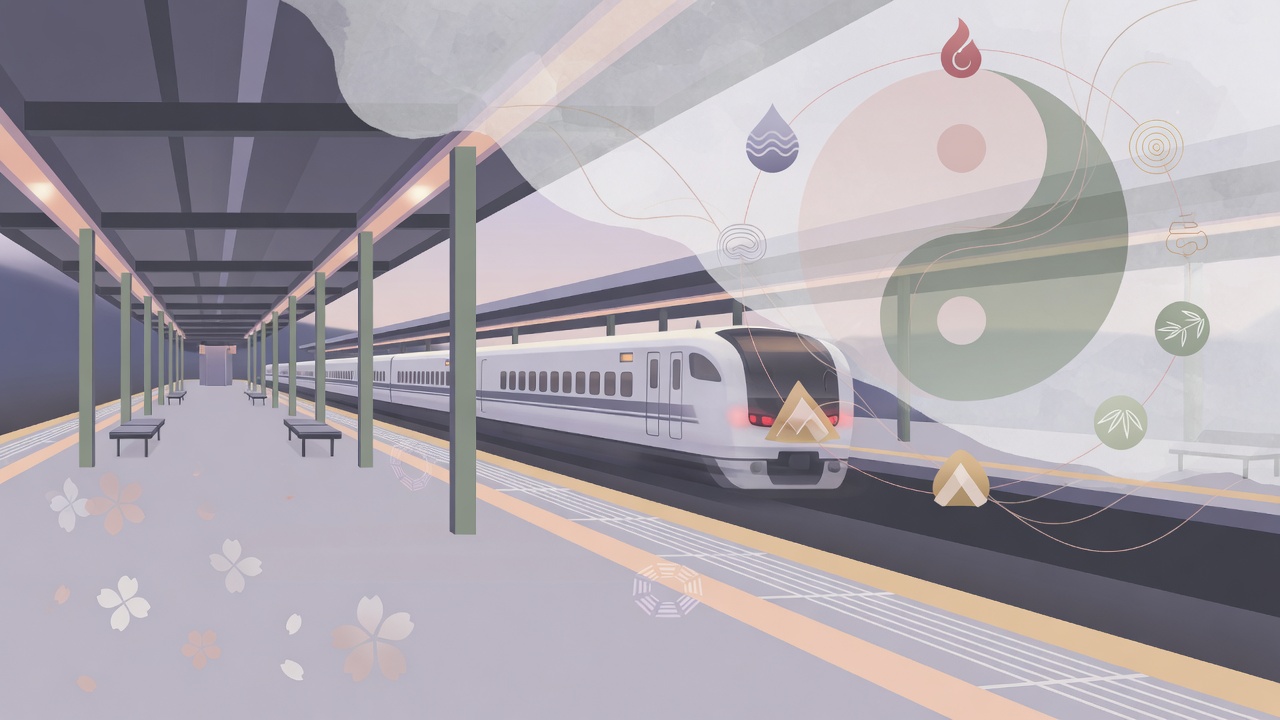
A recent incident in Japan of a train stopping 140 meters past the platform, without reversing, sparked widespread discussion. This article does not judge the event itself but uses this image of 'inertial gliding' to rationally analyze behavioral ten
Introduction
A recent minor incident in Japan, where a train overshot the station by 140 meters, has stirred online debate. Why didn't it reverse? This is not a simple technical question.
From a Bazi perspective, everyone exhibits a certain behavioral inertia under specific timing conditions. This inertia comes from both character and choice.
Basic Clarifications
Common Misconceptions
We can view similar events as a metaphor for 'inertial gliding,' but Bazi is not used to assert specific social events.
- Misconception 1: Bazi can predict a specific accident. In reality, Bazi only describes energy tendencies and time-space windows, not deterministic events.
- Misconception 2: Bazi determines character, and character determines destiny. Actually, character is just a base color, and the final outcome depends on choice and environment.
- Misconception 3: An unfavorable annual luck is bound to cause problems. Annual luck is just an external energy field; whether it triggers an issue depends on a person's coping pattern.
- Misconception 4: Reading Bazi is about seeing good or bad fortune. Bazi is closer to a system observation, helping understand why one is prone to glide past the stop in certain situations.
Core Points
Character Base: The Day Master and Behavioral Inertia
The Day Master in Bazi represents a person's core energy. It acts like a train's power system, determining the basic patterns of starting, accelerating, and braking.
Some Day Masters lean towards being robust, tending to push forward when encountering obstacles; others lean towards gentle compliance, tending to wait passively when blocked.
- Wood Day Master: Grows and rises upwards, but sometimes single-minded, wanting to 'move forward' even more after missing a turning point.
- Fire Day Master: Reacts quickly, prone to impulsive starts, but lacks sustained energy and might forget to turn back.
- Earth Day Master: Steady and slow, accustomed to observing before acting, but unwilling to make a fuss after missing the timing.
- Metal Day Master: Has a strong sense of rules, tending to think 'handle it as it stands since we've passed,' not easily reversing course.
- Water Day Master: Flexible and adaptable, but heavily steered by the environment, glides along and finds it hard to actively correct the deviation.
- These are cultural symbolic descriptions, not targeting any specific individual, and are only used for understanding general behavioral tendencies.
Choice Mechanism: How Luck Pillars and Annual Luck Affect Decision Windows
In Bazi, Luck Pillars operate in ten-year cycles, and Annual Luck in one-year cycles. They act like external track signals, suggesting when it is suitable to accelerate or brake.
When the energy of an Annual Luck interacts with an individual's Day Master through clashes or harmonies, judgment can be temporarily altered. Examples include impulsiveness, hesitation, or overconfidence.
- Luck Pillar Clash: It is easy to have a judgment deviation at a critical moment, like being pushed by a crosswind while entering a station.
- Three-Harmony in Annual Luck: This can make a person overly smooth, ignoring the stop line and thinking 'I can still go a bit further.'
- Officer/Ghost Annual Luck: External pressure increases, and one might become excessively cautious or stubbornly push through.
- Resource Annual Luck: Relying on inertia or past experience, unwilling to make temporary changes, even refusing to reverse.
- Wealth Annual Luck: Extremely goal-oriented, possibly sacrificing safety for efficiency and missing the best turnaround point.
- Peer Annual Luck: A competitive or herd mentality, not moving because you see nobody else moving.
- The interaction between different annual lucks and the Day Master determines whether we are more inclined to move forward or stop at a given juncture.
Timing Resonance: How Environment Amplifies Personal Traits
The same Bazi chart can manifest different behaviors under different era backgrounds and social rules. The strict punctuality culture of Japanese trains itself acts as an external five-element constraint.
When a system is too precise, individuals may rely on automatic operation, weakening their capacity for active error correction. This is the implicit shaping of choice by timing.
- High Rule Density: As in Japan's transport system, individuals are more likely to submit to inertia rather than making impromptu judgments.
- Collective Rhythm: When no one around finds it abnormal, an individual may synchronize and tacitly consent, similar to Bazi's Peer group effect.
- Technical Dependency: The higher the degree of automation, the easier it is for people to lower their alertness, corresponding to an overly strong Resource mentality of being taken care of.
- Time Pressure: The margin for error is small during peak times. If an Annual Luck brings a clash, it is easy to have a distorted action under pressure.
- Cultural Context: The Japanese cultural trait of 'not causing trouble for others' might lead one to favor staying silent and not returning to avoid secondary disturbances.
- The external environment is like the annual luck energy field; it can amplify certain Day Master traits and also mask others.
A Guide to Avoiding Pitfalls
Points of Caution
- Don't force-fit Bazi onto news events: The causes of events are complex. Bazi can only provide an individual perspective, not explain all social phenomena.
- Avoid 'character determinism': Character is just a tendency. Choice can be changed through training, just like a train can have manual intervention.
- Annual luck is not a disaster forecast: It is just the climate, not the judgment. When encountering unfavorable annual luck, the key is to adjust your pace, not panic.
- Watch out for the 'inertial gliding' mindset: If you keep overshooting the station in a certain life area, you can review your Day Master traits for a tendency to over-adapt.
- Proactively create 'turnaround points': Before important decisions, deliberately pause for three seconds, which acts as a buffer against annual luck clashes.
- Combine with real-world feedback: Bazi is a map, not the driver. The real road conditions still depend on observation and braking.
- Avoid self-matching: Many people share the same Day Master, but their behaviors differ vastly because acquired choices and environmental variables cannot be ignored.
- View trending topics rationally: No single event can prove a metaphysical rule; it can only serve as material for a thought exercise.
Summary and Review
A train overshooting the station without returning is the result of inertia, rules, and judgment acting together. Bazi culture reminds us: character is the base color, choice is the brake, and timing is the road condition. What truly determines the destination is the ability to soberly hit that brake while gliding.