Bayern 2-2 Arsenal: BaZi Personality, Timing, and Choices Behind the Champions League Draw
A 2-2 Champions League clash saw Bayern held by Arsenal at home, with Declan Rice leveling for the Gunners. This article does not predict outcomes; it rationally unpacks personality traits, timing shifts, and on-field choices in competitive sport thr
Opening Introduction
The Champions League showdown between Bayern and Arsenal ended 2-2, with Rice's crucial equalizer becoming the focal point.
Beyond the scoreline, people often ask: what breeds composure and explosiveness at critical moments? Traditional BaZi culture offers a framework: the interplay of personality, timing, and choice.
This article predicts no real matches; it simply borrows concepts such as the Ten Gods, Luck Pillars, and Useful God from BaZi for a rational science communication.
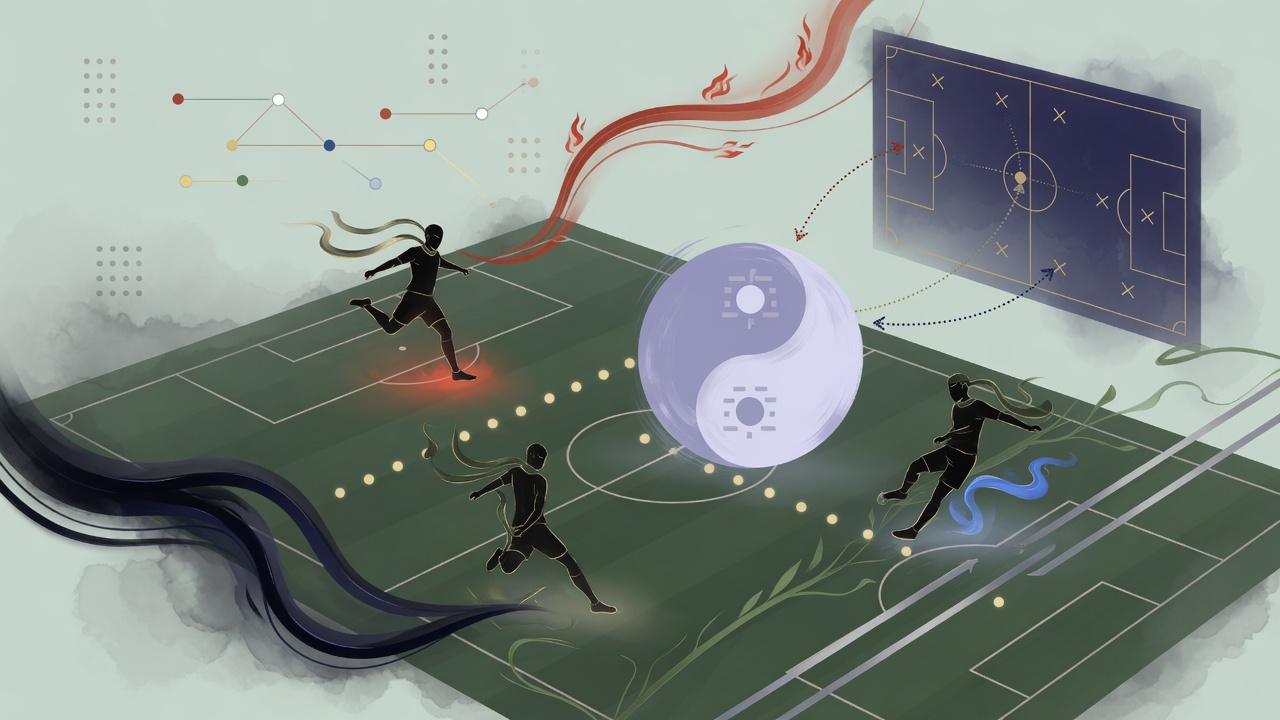
Basic Clarification: BaZi Is Not a Score Predictor
Common Misconceptions
- Misconception 1: BaZi can calculate specific scores or outcomes. In reality, BaZi analyzes trends and inclinations, not deterministic events.
- Misconception 2: People born at the same time share the same fate. BaZi only provides an innate framework; environment, effort, and teamwork matter far more.
- Misconception 3: BaZi only looks at good or bad fortune. The core is understanding the flow of the Five Elements and the configuration of the Ten Gods, helping recognize personal strengths and blind spots.
- Misconception 4: Using a player's public birth date can predict their season performance. This is unreliable and easily violates privacy.
What BaZi Can Do
- BaZi acts more like a personality lens, helping observers see different behavioral patterns in complex situations.
- It emphasizes timing and positioning: the same person displays different states at different stages and in different environments.
- For team sports, BaZi thinking can be used to analyze the rationality of squad composition and role assignment, but not to predict victory or defeat.
Core Points: Personality, Timing, and Choice Through BaZi
Personality Decoding: The Ten Gods Mapped to Pitch Roles
In BaZi, the Ten Gods represent different behavioral tendencies, just as different positions on the pitch require distinct traits.
Each person's chart has stronger or weaker Ten Gods, which determines their first reaction under pressure.
- Seven Killings: Symbolizes decisiveness under high pressure, akin to a finisher who dares to shoot in the final moments. Those with strong Seven Killings often explode in desperate situations, but excess can lead to recklessness.
- Eating God and Hurting Officer: Represent creativity and improvisation, much like a midfielder's flash of inspiration. Overly strong Hurting Officer may lead to excessive risk-taking; Eating God is gentler.
- Direct Officer: Represents discipline and defensive responsibility, similar to a steady defender or goalkeeper. When the Direct Officer is useful, execution is strong and offsides are avoided, but it can sometimes be conservative.
- Friend and Rob Wealth: Reflect teamwork and competitive awareness, corresponding to tacit coordination and positional competition on the field. Too many Friends or Rob Wealth can cause internal friction; clear division of labor is needed.
- Direct Resource: Represents learning and tactical understanding, symbolizing the coaching staff's role in system building. Those with strong Resource stars absorb tactical arrangements well, but may act a bit slowly.
- Indirect Resource: Represents unconventional thinking, potentially bringing unexpected formation changes or set-piece tactics, but stability is slightly lower—prone to both surprising success and mistakes.
- Direct Wealth: Represents pragmatism and execution, corresponding to a player's stable seizing of opportunities, such as calm handling of one-on-ones. When Direct Wealth is useful, the player is usually efficient and practical.
- Indirect Wealth: Represents risk-taking and resource integration, similar to a player's maneuvering in the transfer market or commercial value, rather than on-pitch performance itself. Those with strong Indirect Wealth are good at capturing timing.
- Balance of Seven Killings and Direct Officer: Excess rigidity breaks, excess softness fails. Excellent players often combine discipline and decisiveness, switching between rules and breakthroughs.
- Eating God and Hurting Officer Producing Wealth: Creativity must be converted into tangible results, just as flashy moves must ultimately lead to assists or goals, otherwise they are mere performance.
Timing Dimension: Luck Pillars, Annual Luck, and Season Rhythm
In BaZi, Luck Pillars govern ten-year cycles, and Annual Luck governs yearly changes. A Champions League season is like an Annual Luck, while a player's career stage is like a Luck Pillar.
Timing is not predestined; it is an energy field superimposed by external environment and personal state.
- The form fluctuations in a key match can be likened to the cyclical waxing and waning of the Five Elements' strength in BaZi, but they are not unadjustable.
- Rice's equalizer can be seen as seizing a fleeting opportunity when the team's Useful God (critical timing) appeared.
- BaZi emphasizes waiting for the right moment to act: accumulate strength in ordinary times, and leverage momentum at the critical moment.
- When Annual Luck is unfavorable, strong teams may suffer upsets; but excellent teams know how to adjust the climate, using tactics to compensate for a dip in form.
- A Luck Pillar transition is like a player's leap from rising star to core figure—role changes bring different expectations and pressures.
- The rhythm difference between Champions League group stages and knockout rounds is akin to the weight shift between the Month Branch and Hour Branch in BaZi; the later the stage, the more overall strength matters.
- A team's season trajectory can be viewed as the overlay of multiple months, but every phase has a turning point.
- BaZi does not encourage passive waiting, but reminds us to act boldly in favorable periods and defend cautiously in unfavorable periods.
- The Heavenly Stem of the Annual Luck represents external environment, such as opponent strength and fixture density; the Earthly Branch of the Annual Luck represents internal state, such as injuries and morale.
- True strength is not the absence of low points, but the ability to use low periods to adjust, waiting for the Useful God to become effective again.
Choice Mechanism: Useful God Thinking and On-the-Spot Decisions
The Favorable Useful God in BaZi refers to the Five Element or Ten God that balances the chart and leverages strengths. Applied to choices, it means identifying the most needed strategy at the moment.
Total football or defensive counter-attack? It's like choosing between supporting the weak or adjusting the climate—adjust according to time and place.
- Facing a strong opponent, when Officers and Killings are strong, it is better to defend steadily; when Eating God and Hurting Officer are strong, you can build momentum to attack, but the overall picture must be considered.
- Every touch, every pass is a choice. BaZi culture reminds us: don't act purely on impulse; be aware of your own Five Element preferences.
- Team success depends not only on the strength of an individual's Day Master, but on multiple parties bridging to achieve energy flow.
- The Useful God is not a fixed answer but a dynamic balance. For example, how to substitute when trailing is like remedying deficiencies.
- The bridging mindset in BaZi corresponds to midfield linkage in football: when the forward line and defensive line disconnect, someone needs to harmonize from the middle.
- Climate adjustment is like adapting tactics to weather and pitch conditions—a wet pitch requires fewer short passes, analogous to balancing dryness and dampness in BaZi.
- Choices also involve trade-offs: when certain Ten Gods are overly strong in the chart, another energy is needed to counterbalance, just as tactically sacrificing some attack to strengthen defense.
- Ultimately, BaZi emphasizes self-awareness: understanding your own dominant Ten Gods helps you find your place in the team.
- Decisively strike when the Useful God is strong; patiently maneuver when the Useful God is constrained—not blindly forcing the issue is a mature choice.
- Every draw or result is the outcome of the interaction between the team's overall Useful God and the opponent's chart structure, not the work of a single person.
Avoiding Pitfalls: Rational Approach to BaZi and Football
Rational Advice for Fans
- Do not use BaZi to predict match results: Competitive sport is full of variables; traditional destiny analysis should not be used for gambling or speculation.
- Do not fabricate players' birth charts: Public birth dates may not be accurate, and should not be used to assert a player's character or future, to avoid privacy violations.
- Do not mythologize "predestined fate": BaZi talks about the combination of innate and acquired factors; effort, training, and team tactics are far more important than a birth chart.
- Note for Hong Kong friends: Local football culture is rich, but it is advisable to view BaZi as a cultural observation, not a practical guide.
- Beware of online "masters": Anyone claiming to accurately calculate every Champions League score is mostly a fraud; maintain rational judgment.
Reminders for Traditional Culture Enthusiasts
- Avoid mechanical correspondence: Do not simplistically equate Ten Gods with specific positions; human personality is composite.
- Do not ignore the era context: Modern football's technology, training, and nutrition far surpass ancient conditions; destiny analysis must not detach from reality.
- Respect individual differences: The same Ten God behaves very differently under different Five Element combinations; the whole chart must be viewed.
- Keep an open mind: BaZi is one explanatory tool, not the sole truth.
- Never use for professional decisions: Tactical arrangements and player transfers should be left to professionals; BaZi cannot replace data analysis.
Summary and Recap
A Champions League draw is merely a slice of timing. The true insight from BaZi culture is: personality determines inclination, timing provides the stage, and choices converge into results.
Do not superstitiously predict; simply borrow traditional wisdom to understand the way of balance behind competition.
No matter the score on the field, the arena of life also requires understanding fate without resigning to fate.